Chickpea plants and microorganisms survive on Earth in lunar and Martian soil simulants
Two articles published in the journal Scientific Reports explore the survival capacity of microorganisms and plants in imitations of lunar and Martian soils. In the first, the team succeeded in cultivating chickpea plants in a lunar soil simulant — lunar regolith — treated with arbuscular mycorrhizal fungi and worm compost. In the second article, microbial growth was investigated in a Martian soil simulant with different water proportions and under pressure and temperature conditions similar to those on Earth. At a water level comparable to that on Mars, an atmospheric humidity of 34 %, microbial mass increased, although it fell back to zero after 60 days. “These findings extend the known physicochemical limits of life in solid substrates and provide new insight into the potential habitability of hyper-arid extraterrestrial environments,” the authors say.
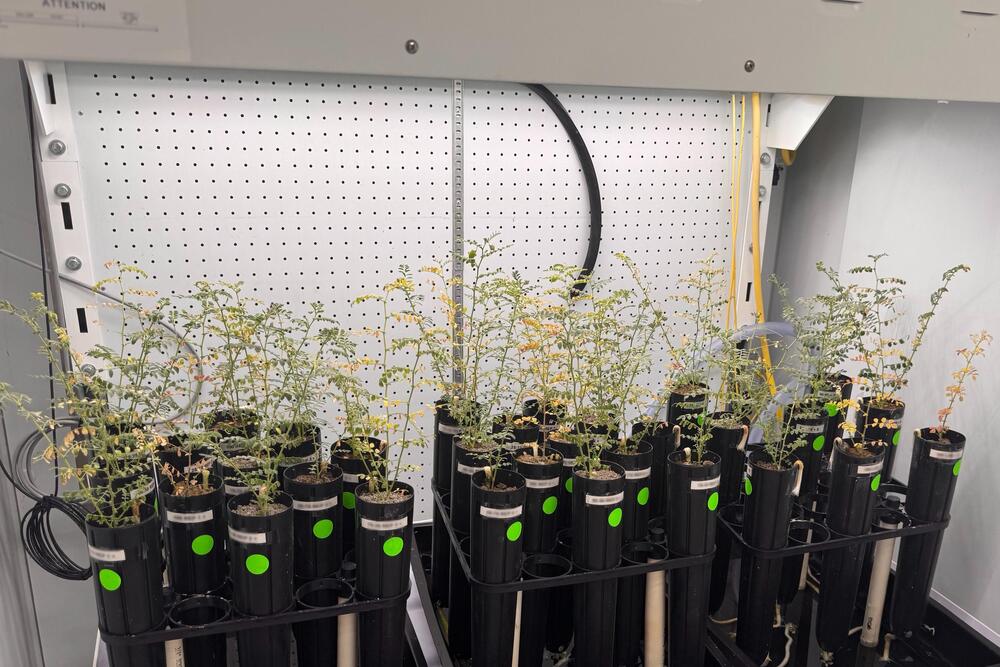
Chickpea plants growing in a variety of the investigated lunar soil simulant mixtures. Jessica Atkin.
2026 03 05 garbanzos Miquel Sureda EN
Miquel Sureda
Doctor of Aerospace Engineering and Research Lecturer at the Polytechnic University of Catalonia
Reaction to the study on cultivation in lunar soil:
"This work strikes me as particularly relevant because it addresses a genuine bottleneck for crewed space exploration: how to turn a regolith-like substrate into a functional medium for bioregenerative life-support systems (food production and resource recycling). The study is well framed as a proof of concept and shows, quite convincingly, that combining organic amendments with microbial symbiosis can improve plant growth and reproduction in a lunar soil simulant, bringing us closer to greenhouse-type scenarios within a habitat.
That said, the results should be interpreted with caution. The experiments were carried out using a simulant and under terrestrial conditions (gravity, atmosphere, radiation and microbiology), so direct extrapolation to the Moon is not yet possible. From an operational perspective, the main limitation is that before we can talk about ‘cultivation’ in lunar environments, further work is needed on safety and scalability issues, such as metal accumulation in edible biomass, system stability over multiple generations, and the real degree of nutrient cycle closure.
Overall, this is a solid and useful step forward in raising the technological maturity of agricultural strategies for space habitats, rather than a demonstration ready for deployment on the lunar surface".
Reaction to the study on microbial growth in Martian soil:
"I see this as a highly interesting study because of its direct implications for habitability and, above all, planetary protection. The central idea — that certain microorganisms might remain active in regolith-like matrices if sufficient water is available in microniches — is plausible and deserves attention, as it affects how we assess the risk of biological contamination on Mars and how we design protocols for surface missions and sample-return operations.
The main limitation concerns the translation of the results. The experiments do not reproduce the full Martian environment (low pressure, CO₂-rich atmosphere, thermal cycles and UV/ionising radiation). In addition, part of the evidence relies on molecular indicators which, while informative, do not in themselves replace a direct and sustained demonstration of growth and metabolism under realistic Martian conditions.
In summary, I see this as an important piece of research pointing to the need to prioritise new experiments under more representative conditions, and reinforcing a cautious approach to planetary protection. It is not evidence of ‘life on Mars’, but rather a result that helps refine where potential niches might exist and what operational risks we should take into account".
Jessica Atkin et al.
- Research article
- Peer reviewed
- Experimental study
Jyothi Basapathi Raghavendra et al.
- Research article
- Peer reviewed